
Building Dialogue

Helping you plan and facilitate difficult dialogues

Three Levels of Discussion

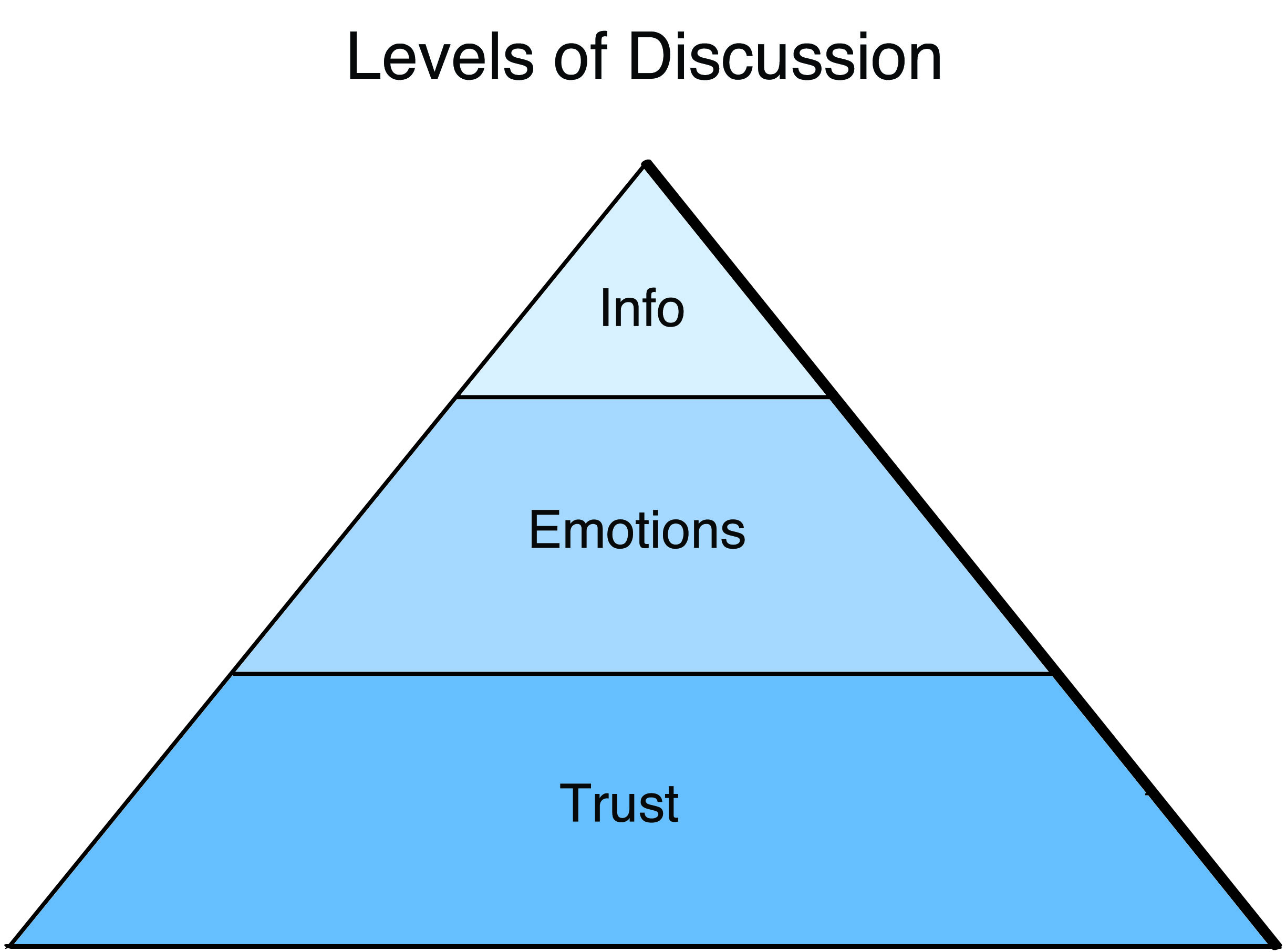
When parties lack trust or when emotions run high, it is difficult if not impossible for them to accurately process information.  If participants cannot process new information, it is unlikely that they will resolve their dispute.  In helping others work through conflict, you have to pay attention to three levels of discussion: how do the parties view themselves and each other (trust/identity), what feelings are present (emotion), what data and experiences has each seen or viewed (information).  If there are serious differences at the trust and emotion levels, those need to be addressed before or in conjunction with the introduction or sharing of information.  If issues of trust or emotion are ignored, the level of conflict is likely to deepen, and participants are likely to anchor more firmly in their original point of view.

If you would like to learn more about moving through these types of issues, please contact us at info@buildingdialogue.com.

CATEGORIES

10 responses to “Three Levels of Discussion”

  1. […] determining how to move forward.  This includes analyzing both the sources of conflict  and the level at which they are occurring.   If there is little trust, or of even greater concern, patterns of […]

  2. […] Three Levels of Discussion […]

  3. […] also review the series on Sternberg’s Taxonomy of Hate, and the series on understanding the different levels and sources of conflict.  These posts will also help you think about why certain issues become highly politicized and […]

  4. […] facilitator can also note and explore the fact that “us v. them” phrasing indicates a lack of trust or identity with others in the conversation.  For example, the facilitator might say “so you see this as […]

  5. […] labeling” is a type of “us” v. “them” thinking that reflects very low levels of trust of those who have different views or experiences.  Sometimes humor can help a speaker move […]

  6. […] the fear of a possible default on our national debt.  Will reason and statesmanship prevail over distrust, misinformation and power-based gamesmanship?  We can hope that it will, and we can also each […]

  7. […] The students also used the “pie chart” illustration of sources of conflict, “iceberg” chart of levels of conflict, and conflict maps, to analyze in advance where participants […]

  8. […] to sympathize with emotions, or to recognize their voices should be heard. There is always some level of the message being offered that can draw a response which demonstrates respect. Respect builds trust; disrespect […]

  9. […] and IF = information) and then sort those later into the corresponding sections of the spreadsheet. Levels of intensity can also be marked on the notes with a + corresponding to higher levels of emotion and ++indicating […]

  10. […] boundaries that may not be clearly identified.) You can also analyze participant interactions at three levels of discussion: (1) how they view themselves and each other (trust/identity), (2) what feelings are […]

Leave a Reply

Recent Posts

Series & Categories

Copyright

© The Communications Center, Inc. and buildingdialogue.wordpress.com, 2010-Present. Unauthorized use or duplication of this material without express and written permission from this blog’s author or owner is strictly prohibited. Excerpts and links may be used, provided that full and clear credit is given to The Communications Center, Inc. and buildingdialogue.wordpress.com with appropriate and specific direction to the original content.

Discover more from Building Dialogue

Subscribe now to keep reading and get access to the full archive.

Continue reading